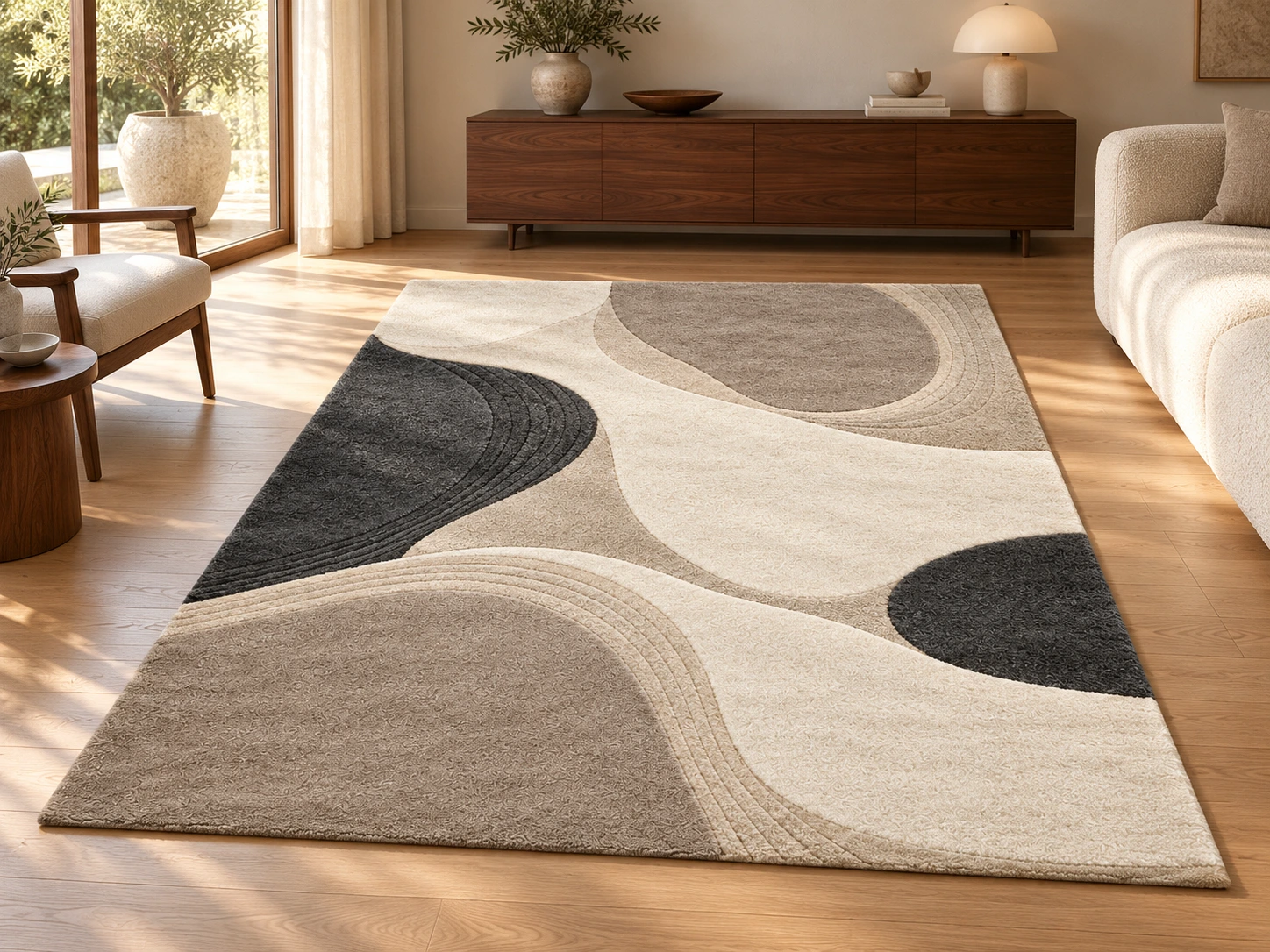
A hand-tufted rug is made by punching yarn through a stretched fabric backing with a handheld tufting gun, following a pattern drawn or stencilled onto the fabric. The loops of yarn are then sheared to create pile, and a secondary backing — usually cotton or latex-coated fabric — is glued or stitched on to hold everything in place. A skilled operator still guides the gun by hand, so it is a genuine hand process, just a mechanically assisted one.
How to identify one
Flip the rug over. A hand-tufted rug has a fabric backing on the reverse, usually canvas-coloured or white, which completely hides the knot structure. You will see the backing material, not individual yarn knots.
Why it matters to a buyer
Hand-tufting is significantly faster and less expensive to produce than hand-knotting, and it allows for more intricate custom artwork, carved pile effects, and shorter lead times. The trade-off is durability: because the pile is held by an adhesive backing rather than woven into the structure, hand-tufted rugs are more vulnerable to the backing separating over time, especially under heavy foot traffic. It is the right choice for trend-led collections, faster turnarounds, and price-sensitive price points.